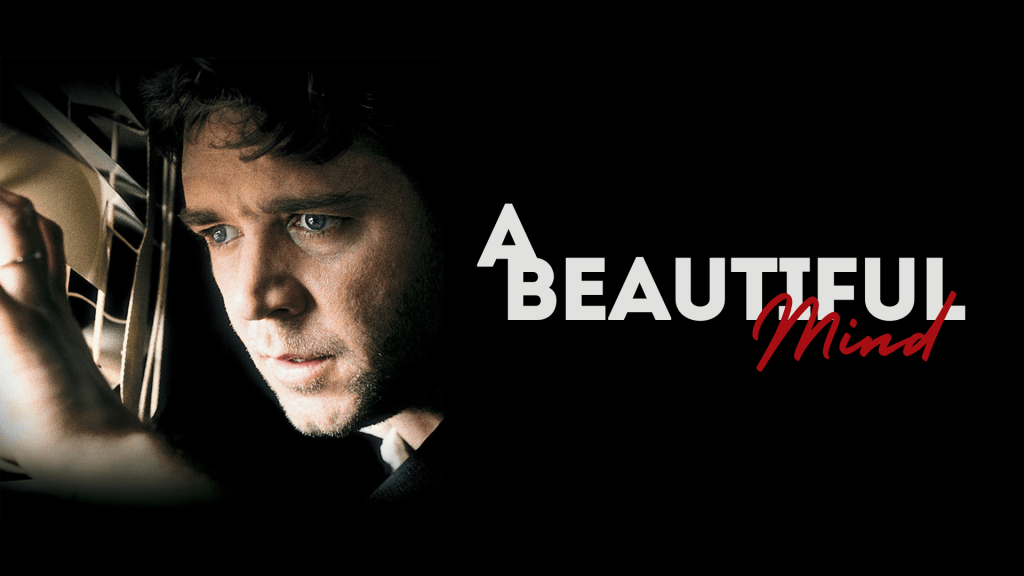
Hi all, I haven’t been posting as frequently as I liked during the school year due to the workload. However, after watching A Beautiful Mind, an American Biographical film about the inventor of Game Theory, John Nash, it felt right to share my thoughts as well as a brief summary on this movie. “A Beautiful Mind,” directed by Ron Howard and released in 2001, is a biographical drama film that chronicles the life of the brilliant mathematician John Nash. This cinematic masterpiece not only tells the poignant story of Nash’s struggles with mental illness but also highlights his groundbreaking contributions to game theory, a field that has significantly influenced economics. This article provides a detailed summary of the movie and explores how Nash’s work has left an enduring impact on economic theory.
To start off, Russell Crowe plays John Nash. The movie begins with his arrival at Princeton to pursue a Ph.D. in mathematics. Nash’s unorthodox intelligence still makes him the center of attention. Yet he pulls off his fair share of cons: he solves problems in his head, then presents only the solutions as if they’re the work of the entire class. Crowe makes the “good will” scene work better than any of his previous leading-man performances. Then we see the transition: what makes the movie interesting is the several ways in which it hides the next transition, pushing the audience onward toward the eventual surprise of Nash’s mental illness.
Despite the private problems he coped with, “A Beautiful Mind” investigates Nash’s work in game theory, paying particular attention to his argument for the Nash Equilibrium. The filmmakers show Nash in his intellectual environment at Princeton and Carnegie Mellon, fooling around with game theory, especially during Nash’s prime research period in the 1950s. Throughout the movie, the audience is made aware of the profound effect Nash’s idea for the Nash Equilibrium has had in the discipline of economics. In this post, I too will pay homage to Nash’s excellent idea and explain what kind of war that Nash and the filmmakers seem to think goes on in the next-to-last scene of the movie.
Nash’s work on oligopoly competition has profound implications for the economy. In a marketplace where a handful of firms reign supreme, Nash tells us that the firms will make you-pay-me decisions. When they do so, they will follow up with decisions that consider what the other few firms are doing. Not only is Nash’s insights useful for understanding what those few firms will do, but also for understanding quite closely something that pertains even more fundamentally to the common weal: regulation and antitrust. And Loungani and his tools tell us that regulation and antitrust are worth raising (Sharpe 2005).
Public policy has absorbed the Nash Equilibrium as one of its principal tools. The reason why is clear: game theory gives a way to think systematically about how our policies might be seen by relevant parties—with no hint of any implicit threat—and how those parties might then interact when they have conflicting interests. Game theory, in its various forms, has been the basis for this kind of US policymaking for the last 60 years. It was not only Nash’s important early insights that contributed to this intellectual revolution; it was also the fact that “A Beautiful Mind” eventually came to contain a recantation of sorts, because its main subject had been also its main victim.
Through its vivid storytelling, the film has no doubt introduced complex mathematical ideas to the audience. The viewers unfamiliar with the concepts of game theory are now awash in a Nash Equilibrium. Because of the film, Nash’s name is now synonymous with crazy, and his ideas with breakthroughs in human behavior studies. Especially, considering how widespread his theories are, whether said/used explicitly in public health/economics/policy or not.
 cognitivecents.com
Leave a comment